.png)

.svg)




TL;DR:
- A clear content strategy aligns content with business goals, driving sustainable growth and ROI.
- Implementing the pillar-cluster SEO model boosts visibility and authority without large budgets.
- Mapping content to each buyer journey stage increases lead generation and long-term business success.
If you’re publishing blog posts, social updates, and videos without a clear plan behind them, you’re not alone. Many small and medium-sized businesses fall into the trap of treating content as a tick-box exercise, producing more in the hope that volume alone will drive results. It won’t. Content strategy aligns creation with your actual business goals, ensuring every piece of content serves a purpose and uses your resources efficiently. This guide breaks down what a genuine content strategy looks like, why it’s essential for sustainable growth, and how you can start applying it to generate real, measurable outcomes.
Table of Contents
- What is content strategy and why does it matter?
- How content strategy drives growth and ROI
- Content strategy as the backbone of SEO and discoverability
- Supporting the buyer journey and long-term growth
- Why most SMBs ignore strategy—and what actually works
- How Geo Growth Media can make content strategy your growth engine
- Frequently asked questions
Key Takeaways
| Point | Details |
|---|---|
| Aligns to business goals | A robust content strategy connects your marketing with concrete business outcomes and efficient resource use. |
| Delivers more leads for less | Strategic content generates more leads at a much lower cost than traditional marketing approaches. |
| Powers sustainable SEO growth | Content strategy is essential for building search authority, organic traffic, and long-term brand visibility. |
| Nurtures customers across funnel | Well-planned content supports every phase of the buyer journey from awareness to decision. |
| Reduces failure risk | Not having a strategy leads to wasted effort; documented plans greatly improve results and ROI. |
What is content strategy and why does it matter?
Content strategy is the deliberate plan behind everything you create and publish. It defines who you’re speaking to, what problems you’re solving, which formats and channels you’ll use, and how success will be measured. It’s the difference between writing a blog post because it’s Tuesday and writing one because you’ve identified a specific question your ideal customer is Googling at the moment they’re closest to buying.
Many business owners confuse content strategy with content marketing. They’re related, but not the same. Content marketing is the execution side: the articles, videos, emails, and social posts. Strategy is the framework that gives all of that direction. Without strategy, content marketing is just noise. Understanding the distinction between content marketing and social media is a useful starting point for building that framework.
A solid content strategy supports multiple business goals at once:
- Lead generation: attracting the right audience at the right stage of their buying journey
- Brand awareness: establishing your business as a credible, go-to source in your sector
- Customer retention: keeping existing customers engaged and informed
- Operational efficiency: reducing wasted effort on content that doesn’t perform
- SEO performance: building sustainable organic visibility over time
Here’s the uncomfortable part. Only 47% of marketers have a documented content strategy, and the businesses that lack one consistently point to unclear goals, poor planning, and misaligned execution as the reasons their content efforts fail. That’s not a content problem. It’s a strategy problem.
“A documented content strategy is the single biggest differentiator between businesses whose content drives growth and those whose content simply takes up time.”
For SMBs especially, where resources are limited and every pound spent needs to justify itself, operating without a documented plan is a costly risk. A well-structured digital strategy for SMBs treats content not as a standalone activity but as a core pillar of your overall marketing and growth efforts.
How content strategy drives growth and ROI
Let’s get specific about what strategic content planning actually delivers, because the numbers are striking.
Content marketing costs 62% less than traditional marketing while generating three times more leads. For an SMB working within tight budgets, that’s not a marginal improvement. That’s a fundamental shift in how efficiently you can grow. And when a documented strategy backs the execution, the returns multiply further. Businesses with documented strategies are 3.5 times more successful, with average ROI ranging from 3:1 all the way to 748% for B2B companies.
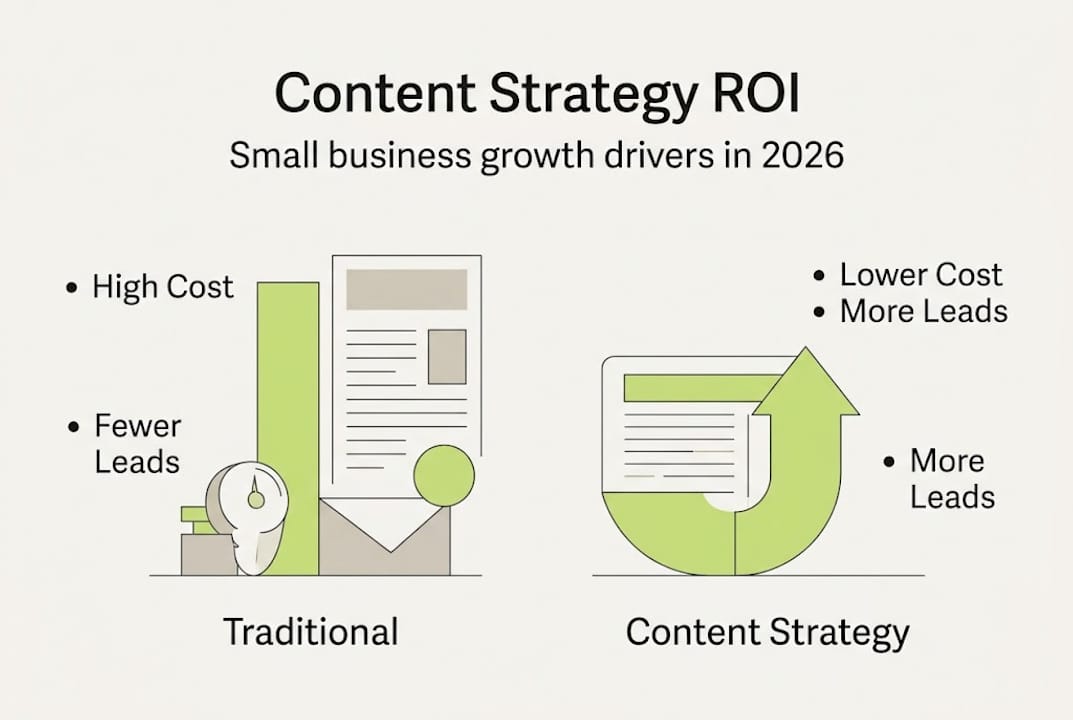
| Metric | Traditional marketing | Strategic content marketing |
|---|---|---|
| Cost per lead | Higher upfront spend | Up to 62% lower |
| Lead volume | Limited by spend | 3x more leads generated |
| Long-term ROI | Stops when spend stops | Compounds over time |
| Brand authority | Ad-driven, short-term | Earned, sustainable |
The compounding effect is what separates strategic content from ad-hoc posting. A single well-researched article can generate traffic, leads, and conversions for years. A paid ad stops the moment you stop funding it. You can explore this further in our guide on boosting ROI with strategy.
So where do you start? Here’s a practical sequence for SMBs looking to shift from reactive to strategic:
- Audit what you already have: identify which content has performed and why
- Define your audience clearly: build a simple profile of your ideal customer, their questions, and their pain points
- Set measurable goals: tie content targets to business outcomes such as enquiries, sign-ups, or sales
- Build a content calendar: plan at least 90 days ahead, covering formats, topics, and distribution channels
- Review and iterate: measure performance monthly and adjust based on what the data shows
For a broader view of 2026 SMB content ROI stats, the data makes a compelling case for acting sooner rather than later.
Pro Tip: Prioritise evergreen content, topics that remain relevant regardless of the season or news cycle. A single evergreen article can drive consistent traffic for two to three years, compounding its value with every passing month.
Content strategy as the backbone of SEO and discoverability
You could produce the most insightful content in your industry, but if nobody can find it, it serves no purpose. This is where content strategy and SEO become inseparable.

One of the most effective frameworks for SMBs is the pillar-cluster model. A pillar page covers a broad topic in depth, while cluster pages tackle specific subtopics that link back to the pillar. This structure signals topical authority to search engines, which in turn improves your rankings across an entire subject area rather than just one keyword. The pillar-cluster model builds topical authority steadily, improving long-term visibility without relying on paid advertising.
| Content type | Purpose | Example |
|---|---|---|
| Pillar page | Broad topic authority | “The complete guide to content marketing” |
| Cluster page | Specific subtopic depth | “How to write a content brief” |
| Supporting blog | Long-tail queries and traffic | “Content brief template for SMBs” |
For SMBs, this model is particularly powerful because it allows you to compete on expertise rather than on budget. You don’t need to outspend a larger competitor. You need to out-think them.
Here’s how to align your content strategy with SEO from the outset:
- Conduct keyword research before writing: find terms your audience is actively searching for
- Group topics into themes: build clusters around your core service or product areas
- Optimise on-page elements: titles, meta descriptions, headings, and internal links all matter
- Build internal links consistently: connecting related content helps search engines understand your site’s structure
- Track organic performance: monitor rankings, traffic, and conversions monthly
Our SEO content planning guide walks through this process in detail for businesses looking to grow through search. You can also review SEO strategy examples tailored to SMB contexts, as well as SMB SEO best practices for building a sustainable foundation.
Supporting the buyer journey and long-term growth
A content strategy that only focuses on attracting new visitors is leaving significant value on the table. The most effective strategies map content to every stage of the buyer journey, from first awareness through to decision and beyond.
83% of marketers say content marketing is the most effective channel for demand generation, precisely because it can nurture leads across every funnel stage rather than targeting one moment in isolation.
Here’s how the funnel maps to content type:
- Awareness stage: blog posts, social content, and short-form video that address problems your audience is experiencing
- Consideration stage: guides, comparison articles, case studies, and webinars that help prospects evaluate their options
- Decision stage: testimonials, detailed service pages, FAQs, and free consultations that remove final objections
To put this into practice, follow these steps:
- List your customers’ most common questions: at each stage of their journey, what are they asking?
- Assign content formats to each stage: not every question needs a 2,000-word article; some are better answered with a short video or infographic
- Create content that bridges stages: a well-placed internal link or a content upgrade (such as a downloadable guide) can move a reader from awareness to consideration in a single session
- Measure progression, not just traffic: track how content moves people closer to a conversion, not just how many people land on a page
Pro Tip: Map your five most frequently asked sales questions to content pieces. These questions represent real buying friction. Answering them in your content reduces that friction before the sales conversation even starts.
Understanding marketing’s role in the buyer journey is critical for marketing managers who want to align their team’s content output with commercial outcomes, not just content metrics.
Why most SMBs ignore strategy—and what actually works
Here’s an observation we’ve made working across a wide range of SMBs: most businesses don’t lack content ideas. They lack the systems to execute on a strategy consistently. The result is a pattern of bursts followed by silence, which signals unreliability to both search engines and potential customers.
The common pitfalls are predictable. Businesses focus on tactics because tactics feel productive. Posting on Instagram feels like marketing. Writing a blog post feels like SEO. But without a strategy connecting those actions to outcomes, you’re measuring activity rather than impact. Over 90% of marketers invest in content, yet many still fail because planning stops at the content calendar and never reaches revenue attribution.
What actually works, based on in-market experience:
- Start with your ideal customer profile (ICP): content built around a specific audience consistently outperforms broad, generic content
- Use the pillar-cluster model: pillar-cluster methodology and ICP-driven topic selection outperform volume-based approaches every time
- Measure what matters: traffic is a vanity metric. Track leads, conversions, and revenue contribution
- Keep human oversight over AI tools: AI can speed up execution but strategy, tone, and judgement must remain human-led
- Review quarterly: a strategy that isn’t reviewed becomes a relic within six months
The role of marketing managers is to hold the strategy together, ensuring that each piece of content serves the wider growth plan rather than existing in isolation.
How Geo Growth Media can make content strategy your growth engine
Ready to move your organisation from content chaos to strategic growth?
At Geo Growth Media, we work as an extension of your marketing team, building content strategies tailored to your goals, sector, and budget. We combine SEO expertise with full-funnel content planning, paid social media strategies, and conversion-focused landing page design to ensure your content doesn’t just exist but actively drives leads and revenue. Whether you’re starting from scratch or looking to sharpen an existing approach, we build strategies grounded in data and focused on measurable results. Get in touch for a tailored growth plan built around your business.
Frequently asked questions
How does content strategy help small businesses compete with larger brands?
A strong content strategy lets SMBs build authority and trust through expertise rather than budget, creating compounding assets like evergreen content that continue generating value long after publication.
What’s the difference between content strategy and content marketing?
Content strategy sets the direction, goals, and framework for all content activity, while content marketing is the execution and distribution. One without the other produces inconsistent results, as documented by HubSpot.
Why do most content strategies fail for SMBs?
Only 47% of marketers operate with a documented strategy, and most failures trace back to unclear goals, insufficient planning, and a lack of measurement beyond vanity metrics.
How quickly can I see results from a content strategy?
Results build steadily over time, with measurable growth typically visible after three to six months. Businesses with documented strategies are 3.5 times more likely to see sustained success compared to those operating without a plan.


.png)